




Scientific Principles and Technical Advantages of Platinum-Titanium Anode Plates
In the field of electrochemistry, platinum-titanium anode plates represent an outstanding integration of materials engineering and electrochemical technology. Through the synergistic effect of the structural stability of the titanium substrate and the catalytic activity of the platinum coating, they achieve high-efficiency and durable electrochemical performance. The widespread application of this composite material in fields such as wastewater treatment, precious metal electroplating, and the chlor-alkali industry demonstrates its unique technical value.
Material Structure and Manufacturing Process
Platinum-titanium anode plates adopt a composite structural design of "titanium substrate–platinum coating":
Substrate Material: Industrial pure titanium (TA1/TA2) features low density (4.51 g/cm³), high strength (tensile strength ≥240 MPa), and excellent corrosion resistance, particularly forming a stable passivation film in chlorine-containing environments.
Surface Coating: A micron-level platinum layer (typically 1–5 μm thick) is formed on the titanium surface via techniques such as electroplating, thermal decomposition, or physical vapor deposition. Its nanostructured porosity significantly increases the effective reaction area.
Interface Bonding: Surface activation pre-treatment (e.g., sandblasting, acid etching) and intermediate transition layer design ensure strong adhesion between the platinum coating and titanium substrate (adhesion can reach ASTM D3359 Grade 4B or higher).

Electrochemical Performance Advantages
The exceptional performance of platinum-titanium anode plates stems from their unique electrochemical characteristics:
| Performance Dimension | Technical Performance | Application Value |
|---|---|---|
| Low Overpotential Characteristic | Oxygen evolution potential reduced by 200–400 mV compared to traditional electrodes | Significantly lowers electrolysis energy consumption and improves current efficiency |
| Anti-Passivation Capability | Maintains surface activity in strongly oxidizing media | Suitable for harsh operating conditions such as high-potential electrolysis and electrocatalytic oxidation |
| Catalytic Activity Stability | Platinum coating activity decay <10% after prolonged operation | Ensures process stability and product consistency |
| Wide Potential Window | Operating potential range up to +2.0 V to -0.5 V (vs. SCE) | Adapts to various redox reaction requirements |
Analysis of Core Application Areas
1. Advanced Oxidation Water Treatment
In electrochemical advanced oxidation processes (EAOPs), platinum-titanium anodes achieve efficient pollutant degradation through the following mechanisms:
Direct oxidation: Pollutants undergo electron transfer reactions at the anode surface.
Indirect oxidation: The anode generates strong oxidants such as hydroxyl radicals (•OH) and ozone.
Electro-Fenton effect: Synergistic generation of hydrogen peroxide with dissolved oxygen.
2. Precious Metal Electroplating and Refining
Provides uniform current distribution (extreme difference <8%) in gold and silver electroplating.
Platinum coating remains stable in cyanide plating baths, preventing anode dissolution contamination.
Suitable for precision processes such as pulse plating and periodic reverse plating.
3. Chlor-Alkali Industry
As an optimized solution for dimensionally stable anodes (DSA®), platinum-titanium anodes demonstrate in NaCl electrolysis:
Chlorine evolution efficiency >95%, with side reactions (oxygen evolution) proportion <3%.
Stable operation even at high current densities of 6 kA/m².
Expected service life of 5–8 years (traditional graphite anodes: 1–2 years).
4. Emerging Energy Fields
Oxygen evolution anode in proton exchange membrane (PEM) water electrolysis for hydrogen production.
Coating material for bipolar plates in fuel cells.
Research electrode for electrochemical carbon dioxide reduction reactions (CO2RR).
Technological Development Trends
Surface Engineering Innovations
Nanostructured design: Preparation of hierarchical porous platinum coatings via templating or dealloying techniques, increasing specific surface area by 3–5 times.
Alloying modifications: Platinum-iridium, platinum-ruthenium, and other alloy coatings demonstrate better selectivity and stability in specific reactions.
Gradient functional coatings: Composition and structure gradients from substrate to surface, balancing bonding strength and catalytic activity.
Intelligentization and Integration
Embedded sensors: Real-time monitoring of coating wear, temperature distribution, and current efficiency.
Self-healing coating technologies: Damage repair mechanisms based on shape-memory alloys or microcapsules.
Modular design: Standardized electrode units support quick replacement and system expansion.
Green Manufacturing and Recycling
Low-platinum/platinum-free coating technologies: Development of transition metal oxide alternatives.
Electrode regeneration processes: Restoration of coating activity via electrochemical activation or heat treatment.
Life cycle assessment (LCA): Optimization of environmental impact from raw material extraction to waste recycling.
Selection and Usage Recommendations
Operating Condition Matching Analysis: Select coating type and thickness based on electrolyte composition (pH, chloride ion concentration), temperature, current density, and other parameters.
Structural Optimization Design: Consider the impact of plate, mesh, or three-dimensional porous structures on mass transfer and current distribution.
Maintenance Monitoring System: Establish online monitoring and early warning mechanisms for key parameters such as electrode potential and cell voltage.
Economic Benefit Evaluation: Conduct full lifecycle cost analysis integrating initial investment, operating energy consumption, maintenance costs, and service life.
Future
As core components of high-performance electrochemical systems, platinum-titanium anode plates will continue to drive energy efficiency improvements and process innovations in related industries through technological advancements. With the development of research tools such as materials computation and in-situ characterization, future innovations may achieve full-chain synergy in "material design → fabrication process → performance optimization," providing more advanced electrode solutions for sustainable electrochemical engineering.
BAOJI NINGHAO INDUSTRY AND TRADE CO., LTD. offers customized development services for platinum-titanium anode plates, covering material selection, coating design, performance testing, and process optimization support. For detailed technical information or application inquiries, please contact: sales02@nh-ti.com.
References
International Journal of Hydrogen Energy. (2023). Platinum‑based Anodes for PEM Water Electrolysis: Performance Benchmarking and Degradation Mechanisms (Special Issue Vol. 48, Issue 65).
Zhang, Y., et al. (2022). Nanostructured Pt‑Ti Anodes for Electrochemical Oxidation of Refractory Organic Pollutants. Applied Catalysis B: Environmental, 319, 121899.
European Electrochemical Engineering Association. (2021). Guidelines for Selection and Operation of Noble Metal Coated Anodes in Industrial Electrolysis (EEEA‑GL‑2021‑08).
Wang, L., & Chen, G. (2023). Advanced Characterization Techniques for Understanding Catalyst‑Substrate Interactions in Coated Electrodes. Journal of Materials Chemistry A, 11(15), 7892‑7910.
YOU MAY LIKE
_1755236535680.webp) VIEW MORETitanium anodes for electrolytic acid-base ionized water
VIEW MORETitanium anodes for electrolytic acid-base ionized water_1755236711229.webp) VIEW MOREMMO Ti flexible anode
VIEW MOREMMO Ti flexible anode_1767855136209.webp) VIEW MOREgrade 1 titanium electrode
VIEW MOREgrade 1 titanium electrode_1767943710775.webp) VIEW MOREcustomized titanium electrode
VIEW MOREcustomized titanium electrode_1768984222648.webp) VIEW MOREplatinized titanium anode for electrolysis
VIEW MOREplatinized titanium anode for electrolysis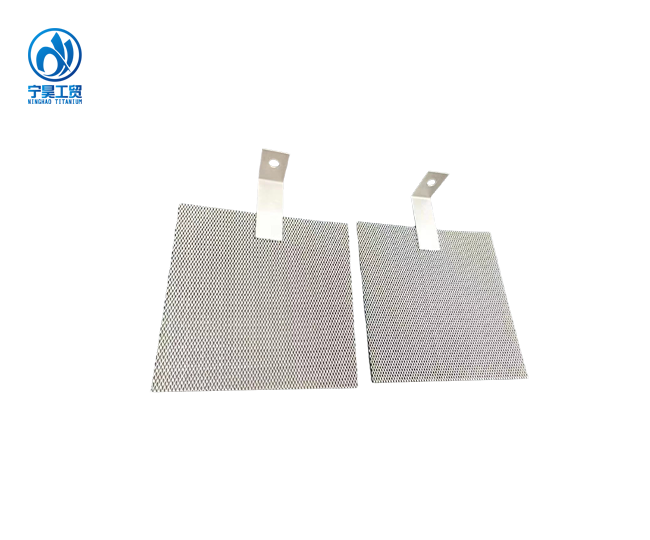 VIEW MOREPlatinum Coated Titanium Electrodes
_1768466869877.webp) VIEW MOREMMO Titanium Electrode for Electrochemical OxidationWastewater Treatment
VIEW MOREMMO Titanium Electrode for Electrochemical OxidationWastewater Treatment_1768809598553.webp) VIEW MOREMMO Anode for Ammonia Removal
VIEW MOREMMO Anode for Ammonia Removal