




Professional Storage Guidelines for Titanium Alloy Electrodes
Titanium alloy electrodes, as critical components in fields such as electrochemistry, aerospace, and medical applications, have performance stability that directly affects application effectiveness and service life. Proper storage methods not only protect electrodes from environmental damage but also maintain their surface activity and structural integrity, laying the foundation for subsequent efficient applications.
Analysis of Storage Failure Mechanisms
Risks that may arise from improper storage include:
Surface Oxidation/Passivation: Formation of excessively thick oxide films (>10 nm) on titanium surfaces in humid environments, affecting electron transfer efficiency.
Contaminant Adsorption: Adsorption of sulfides, chlorides, or organic volatiles from the air onto the electrode surface, leading to reduced catalytic activity.
Mechanical Damage: Microscopic scratches caused by improper stacking or vibration, serving as initiation points for corrosion.
Coating Delamination: Interface stress due to differences in thermal expansion coefficients between coating and substrate caused by drastic temperature and humidity changes.
Control Standards for Key Storage Parameters
| Control Parameter | Recommended Range | Risks of Exceeding Limits |
|---|---|---|
| Temperature | 15‑25°C (stable ±2°C) | >30°C accelerates oxidation; <10°C may cause condensation |
| Relative Humidity | 40‑60% RH | >70% promotes electrochemical corrosion; <30% may cause electrostatic adsorption |
| Cleanliness | ISO 14644-1 Class 7 (10,000 class) or higher | Particulate contamination leading to surface defects |
| Light Exposure | Store in darkness, especially avoid direct UV exposure | UV radiation induces surface organic photodegradation |
| Vibration | ≤0.5 g RMS (10‑200 Hz) | Mechanical fatigue leading to microcracks |
Tiered Storage Solutions
1. Short-Term Storage (<30 Days)
Packaging Requirements: Individual electrodes sealed in anti-static polyethylene bags with desiccant (silica gel, humidity-indicating type) inside.
Placement Method: Horizontally placed on anti-vibration racks, avoiding stacking.
Environmental Monitoring: Daily recording of temperature and humidity; variation amplitude not exceeding ±10% of set values.
2. Medium-Term Storage (30‑180 Days)
Inert Gas Protection: Sealed containers filled with nitrogen gas (purity ≥99.999%, dew point ≤-40°C).
Surface Pre-Treatment: Wipe with high-purity ethanol (≥99.8%) before storage to remove fingerprints and organic residues.
Regular Inspection: Open-box sampling inspection every 30 days (surface morphology, contact resistance).
3. Long-Term Storage (>180 Days)
Vacuum Sealing: Use aluminum-plastic composite vacuum bags (water/oxygen transmission rate <0.1 g/m²·day).
Electrode Status Records: Establish archives recording initial parameters such as surface roughness (Ra), contact resistance, and coating thickness.
Accelerated Aging Tests: Periodic sampling for electrochemical impedance spectroscopy (EIS) tests to evaluate performance degradation.
Special Electrode Storage Key Points
| Electrode Type | Storage Key Points |
|---|---|
| MMO-Coated Electrodes | Avoid reducing atmospheres (H₂, CO) to prevent reduction of precious metal oxides in coating. |
| Platinum/Iridium-Coated Electrodes | Complete darkness required; UV light may catalyze coating lattice reorganization. |
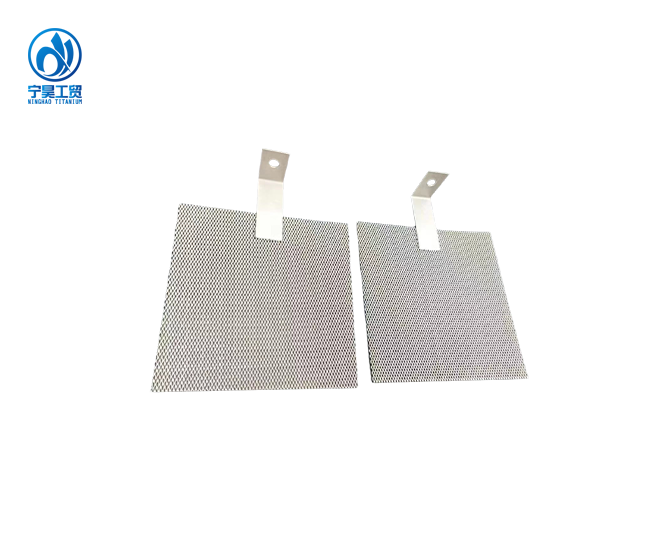
| Porous/Mesh Electrodes | Store vertically suspended to prevent structural deformation due to self-weight. |
| Flexible Linear Electrodes | Coil diameter should be >30 times electrode diameter to avoid plastic deformation. |
Storage Facility Configuration Recommendations
Constant Temperature and Humidity Warehouse: Equipped with independent air conditioning system and redundant dehumidification devices.
Multi-Level Shelving System: Use anti-static coated shelves with grounding resistance <1 Ω.
Gas-Protected Cabinets: Equipped with automatic gas replenishment and oxygen content monitoring (O₂ <100 ppm).
Digital Management: Use RFID tags to achieve full-process traceability of batch, location, and storage conditions.
Pre-Use Processing Flow Before Retrieval
Equilibration Treatment: Allow 2‑4 hours at room temperature after removal from low-temperature/inert environments.
Surface Activation: Perform electrochemical activation as required by application (e.g., cyclic voltammetry scanning).
Performance Verification: Measure parameters such as open-circuit potential and double-layer capacitance, comparing with pre-storage data.
Emergency Response Plans
Excessive Humidity: Immediately transfer to drying oven, low-vacuum drying at 50°C (10⁻² Pa).
Surface Contamination: Use plasma cleaning (Ar atmosphere, 100 W, 5‑10 min).
Mechanical Damage: Minor scratches can be repaired by electrochemical polishing (phosphoric acid‑ethylene glycol system).
Economic Analysis
Although reasonable storage increases initial investment (approximately 3‑5% of total procurement cost), it can:
Extend electrode lifespan by 30‑50%
Reduce defect rates due to performance degradation
Minimize emergency procurement and production stoppage losses
Achieving a 15‑25% reduction in total lifecycle costs.
Technological Development Trends
Intelligent Storage Systems: Integration of IoT sensors for real-time monitoring and automatic adjustment of temperature, humidity, and gas composition.
Self-Protective Coatings: Development of smart coatings with self-healing functions, reducing storage environment requirements.
Digital Twins: Establishment of multi-physics field models for electrode storage processes to optimize storage parameters.

BAOJI NINGHAO INDUSTRY AND TRADE CO., LTD. provides professional storage consultation and customized packaging solutions for titanium alloy electrodes, including inert gas sealing equipment, specialized storage containers, and environmental monitoring systems. For detailed storage solutions or technical support, please contact: sales02@nh-ti.com
References
International Organization for Standardization. (2022). ISO 19001: Storage Guidelines for Electrochemical Electrodes in Industrial Applications.
Zhang, L., et al. (2023). Degradation Mechanisms of Titanium Alloy Electrodes under Various Storage Conditions: An In‑Situ Study. Corrosion Science, 221, 111356.
European Space Agency. (2021). Materials Storage Protocols for High‑Value Electrochemical Components (ESA‑PSS‑01‑721).
Chen, G., & Wang, H. (2022). Smart Packaging Systems for Corrosion‑Sensitive Electrodes: Design and Validation. Journal of Materials Processing Technology, 308, 117715.
YOU MAY LIKE
_1755236336371.webp) VIEW MOREmmo coated titanium anodes for cathodic protection
VIEW MOREmmo coated titanium anodes for cathodic protection_1755236535680.webp) VIEW MORETitanium anodes for electrolytic acid-base ionized water
VIEW MORETitanium anodes for electrolytic acid-base ionized water_1755236491406.webp) VIEW MORETitanium anode plate for electrodeposition of non-ferrous metals
VIEW MORETitanium anode plate for electrodeposition of non-ferrous metals VIEW MOREDental Titanium Disc
 VIEW MOREtitanium electrodes
_1755237184326.webp) VIEW MOREmmo coated titanium electrode
VIEW MOREmmo coated titanium electrode_1769066426360.webp) VIEW MORETubular electrolyzer for electrochemical wastewater treatment
VIEW MORETubular electrolyzer for electrochemical wastewater treatment_1755238003946.webp) VIEW MORETitanium electrodes for electrochemical water treatment
VIEW MORETitanium electrodes for electrochemical water treatment