




How Grade 1 Titanium Electrodes Are Used in Water Treatment and Energy Production
Against the backdrop of rapidly evolving environmental technology and sustainable energy solutions, Grade 1 titanium electrodes have become key components in various fields. These electrodes play an important role in water treatment processes and energy production systems, providing reliable support for related industries with their stability and durability.
Unique Properties of Grade 1 Titanium Electrodes
Grade 1 titanium, known for its excellent corrosion resistance and durability, serves as an ideal material for electrodes in demanding environments. Its key characteristics include:
Corrosion Resistance: Remains stable in environments containing corrosive substances such as chlorides and sulfates, ensuring long-term service
Biocompatibility: Non-toxic nature makes it suitable for water treatment systems, with no harmful substances released into treated water
Lightweight Yet Strong: Robust structure with relatively low weight, facilitating handling and installation
Good Conductivity: Provides reliable electrical conductivity for electrochemical processes in both water treatment and energy applications
Temperature Adaptability: Maintains structural integrity and performance across a wide range of temperatures
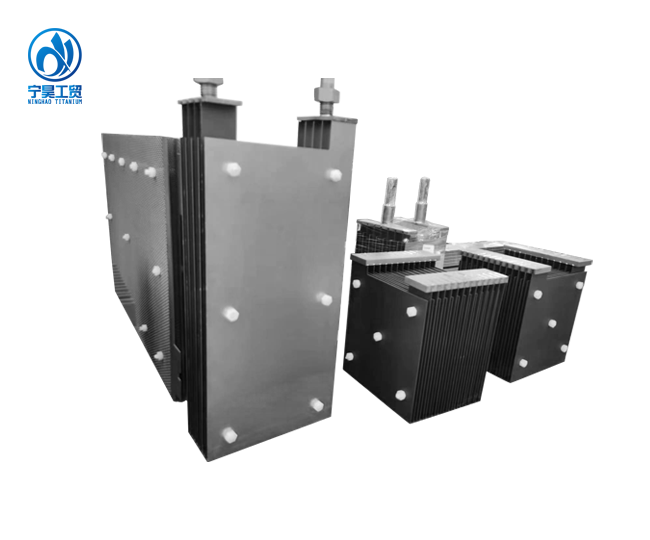
Grade 1 Titanium Electrodes in Water Treatment
The application of Grade 1 titanium electrodes in water treatment processes has improved the efficiency and effectiveness of various purification methods:
Electrocoagulation
In electrocoagulation systems, Grade 1 titanium electrodes serve as cathodes, helping to remove contaminants from water. This process generates coagulants through electrolytic oxidation of an anode (typically aluminum or iron). The titanium cathode assists in floc formation, which adsorbs pollutants and can be removed through sedimentation or filtration.
Electro-oxidation
Grade 1 titanium electrodes coated with Mixed Metal Oxides (MMO) are widely used in electro-oxidation processes for water treatment. These electrodes generate strong oxidants such as hydroxyl radicals, which can effectively degrade organic pollutants and pathogens in water. The durability of Grade 1 titanium ensures long-term performance even in highly oxidizing environments.
Electrochlorination
In seawater and brackish water treatment, Grade 1 titanium electrodes play a crucial role in electrochlorination systems. These systems produce sodium hypochlorite on-site, offering a cost-effective and environmentally friendly disinfection method. The corrosion resistance of Grade 1 titanium makes it suitable for withstanding harsh, chloride-rich environments.
Desalination
Grade 1 titanium electrodes are used in electrodialysis and capacitive deionization desalination systems. These processes rely on the electrode's ability to selectively remove ions from water. The durability and conductivity of Grade 1 titanium electrodes contribute to the efficiency and service life of these desalination systems.
Grade 1 Titanium Electrodes in Energy Production
Beyond water treatment, Grade 1 titanium electrodes also play a role in various energy production applications:
Fuel Cells
In fuel cell technology, Grade 1 titanium electrodes serve as substrates for catalysts. Their corrosion resistance and conductivity make them suitable for use in proton exchange membrane (PEM) fuel cells and solid oxide fuel cells (SOFCs), contributing to the efficiency and durability of these systems.
Redox Flow Batteries
Grade 1 titanium electrodes are important components in redox flow batteries, which are gaining attention as large-scale energy storage solutions. The corrosion resistance and stability of titanium in acidic electrolytes make it suitable for the redox reactions that store and release energy.
Hydrogen Production
In the field of green hydrogen production, Grade 1 titanium electrodes are used in water electrolysis systems. These electrodes, often coated with catalytic materials, enable the efficient splitting of water into hydrogen and oxygen. The durability of Grade 1 titanium ensures long-term performance in alkaline and PEM electrolyzers.
Geothermal Power Generation
Grade 1 titanium electrodes are used in geothermal power plants, particularly in binary cycle systems. These electrodes are applied in heat exchangers and other components exposed to geothermal fluids. The corrosion resistance of Grade 1 titanium helps ensure the service life and efficiency of these systems.
Conclusion
The applications of Grade 1 titanium electrodes in water treatment and energy production demonstrate the important role of advanced materials in addressing challenges related to water scarcity and sustainable energy. With their combination of corrosion resistance, durability, and conductivity, these electrodes support more efficient and environmentally friendly processes across various industries.
For more information about Grade 1 titanium electrodes, please contact BAOJI NINGHAO INDUSTRY AND TRADE CO., LTD.: sales02@nh-ti.com
References
1. Smith, J. A., & Johnson, B. C. (2020). Advanced Electrode Materials for Water Treatment and Energy Production. Journal of Electrochemical Science and Technology, 15(3), 245-260.
2. Wang, X., et al. (2019). Grade 1 Titanium Electrodes: Properties and Applications in Environmental Technology. Environmental Science & Technology, 53(12), 6821-6835.
3. Lee, S. H., & Park, Y. J. (2021). Innovations in Water Treatment Using Grade 1 Titanium Electrodes. Water Research, 185, 116279.
4. Chen, G., & Liu, H. (2018). Applications of Titanium-based Electrodes in Energy Storage and Conversion. Energy & Environmental Science, 11(6), 1362-1381.
5. Ramirez, A., et al. (2022). Advancements in Electrode Materials for Sustainable Water and Energy Systems. Progress in Materials Science, 124, 100721.