




Are Platinum-Titanium Anodes Suitable for Marine Applications?
Yes. This is a great question. It gets to the heart of materials science in harsh environments.
Platinum-Titanium anodes (often called Pt-Ti anodes) are very suitable for marine use. They are mainly used in cathodic protection (CP) and electrochlorination systems. Their success comes from a strong combination of titanium's structure and platinum's performance.
1. The Perfect Synergy: Titanium as the Substrate
Titanium is not chosen by chance. It has special properties in seawater.
Excellent Corrosion Resistance: Titanium forms a dense and stable oxide layer on its surface. This layer is mostly TiO₂. It makes titanium nearly inert in seawater. It resists corrosion from chlorides. Chlorides are very aggressive to most other metals.
High Strength-to-Weight Ratio: Titanium provides strong structural support. It can be used in deep water or areas with strong currents and waves. But it is not too heavy.
The "Valve Metal" Property: This is the most important feature. Titanium is a valve metal. This means its oxide film is a semiconductor. It allows current to pass in only one direction.
During Anodic Polarization: When the anode is in use, the oxide layer is highly insulating. This stops the titanium from corroding. It forces the reactions to occur only on the platinum coating.
If the Coating is Damaged: If the platinum layer is scratched, the exposed titanium will not corrode. It immediately repassivates. It forms a new oxide layer. This limits the damage to a small area. It prevents major failure. This is a key advantage over other anode materials.
2. The Superstar Coating: Platinum
A thin layer of platinum is applied to the titanium substrate. This is done through cladding, electroplating, or thermal deposition. Platinum brings its own advantages.
Extreme Catalytic Activity: Platinum is a great catalyst for reactions at the anode. These include oxygen and chlorine evolution. The reactions occur more easily and at lower energy. This makes the system more energy-efficient.
Superior Corrosion Resistance: Platinum is one of the most chemically inert metals. It can withstand highly oxidizing conditions. These include high potentials and aggressive chemicals like chlorine.
High Electrical Conductivity: Platinum is an excellent conductor. It ensures that current is distributed evenly across the anode surface. This leads to uniform performance and a longer life.
Low Consumption Rate: In CP systems, the anode should not be consumed. Platinum has a very low consumption rate. It is usually 2 to 10 milligrams per Ampere-year (mg/A·yr). This means a very long service life. It can last 20 years or more, depending on the current density.
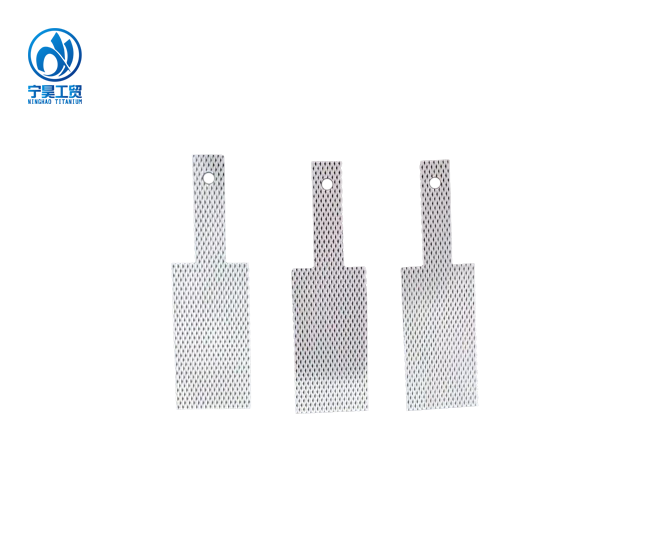
Key Advantages for Specific Marine Applications
A. Cathodic Protection (CP) of Ships and Structures
In CP systems, a DC current is applied to the anode. The anode discharges current into the seawater. This protects a submerged metal structure from corrosion.
High Current Output: Pt-Ti anodes can work at very high current densities. They can reach up to 1000 A/m² without breaking down. This allows for smaller and more compact anode designs.
Longevity and Reliability: Their low consumption rate means they last for decades. This reduces maintenance and replacement costs. This is very important for hard-to-reach offshore structures.
Precision Control: They work well with automated impressed current CP (ICCP) systems. This allows for precise control of the protection level.
B. Seawater Electrochlorination
This is a key process for ships and offshore platforms. Seawater is used for cooling, ballast, or firefighting. The system passes an electric current through seawater between Pt-Ti anodes and cathodes.
Efficient Chlorine Production: The reaction at the Pt-Ti anode produces sodium hypochlorite efficiently. This is a powerful biocide. It comes from the chloride ions in seawater: 2Cl⁻ → Cl₂ + 2e⁻. This chlorine kills marine organisms like algae, barnacles, and mussels. It prevents them from clogging pipes and systems.
Durability in Harsh Conditions: The anode must withstand chlorine, oxygen, and changing pH levels. The Pt-Ti combination is one of the few materials strong enough for this job.
Conclusion
In short, Platinum-Titanium anodes are suitable for marine use. They combine titanium's corrosion resistance and valve-metal safety with platinum's catalytic activity, conductivity, and inertness.
This synergy gives an anode that is:
Very durable and long-lasting
Highly efficient and low-energy
Compact and reliable
Ideal for harsh, chloride-rich marine environments
The initial investment is higher than some alternatives. But the long service life, reduced maintenance, and operational reliability make Pt-Ti anodes the best technical and economic choice for critical marine systems like ICCP and electrochlorination.
Contact Us
For more information about Platinum-Titanium anodes and other electrochemical solutions, please contact: BAOJI NINGHAO INDUSTRY AND TRADE CO., LTD. Email: sales02@nh-ti.com
We are ready to provide expert guidance and customized solutions for your marine and industrial applications.
References
1. Baeckmann, W. V., Schwenk, W., & Prinz, W. (1997). Handbook of Cathodic Corrosion Protection. Gulf Professional Publishing.
2. Revie, R. W., & Uhlig, H. H. (2008). Corrosion and Corrosion Control: An Introduction to Corrosion Science and Engineering. John Wiley & Sons.
3. Trasatti, S. (2000). Electrocatalysis: understanding the success of DSA®. Electrochimica Acta, 45(15-16), 2377-2385.
4. Comninellis, C., & Chen, G. (Eds.). (2010). Electrochemistry for the Environment. Springer Science & Business Media.
5. Roberge, P. R. (2000). Handbook of Corrosion Engineering. McGraw-Hill Education.